eggs · 9 min read
Pasture-Raised, Cage-Free, Free-Range: What the Egg Labels Actually Mean
An $8 dozen of eggs and a $3 dozen of eggs are not the same product. We dug through the certifications, the lab data, and the egg yolks themselves to find out what's really different.

Walk down the egg aisle and you'll find prices that span 4× from cheapest to most expensive — for a product that, on paper, is "twelve eggs." The labels claim a story: cage-free, free-range, pasture-raised, certified humane, omega-3 enriched. Most of those labels are marketing. Two of them are real. Here's how to tell.
The short version: "Cage-free" and "free-range" are USDA terms with very weak meaning. "Pasture-raised" and "Certified Humane: Pasture-Raised" are the only labels with rigorous standards. The yolk color and the price are both signals — but only one is the truth.
The labels, ranked from worst to best
Conventional / "All Natural" / "Farm Fresh"
Translation: No standard at all. The hens are in cages.
A USDA-monitored "battery cage" gives each hen roughly 67 square inches of space — less than a sheet of letter paper. The hens cannot fully spread their wings, dust-bathe, or perch. Most have their beaks trimmed. They live like this for 1-2 years before slaughter. This is what 70% of American eggs still come from.
"Cage-Free"
Translation: Out of cages, but in a packed barn.
Cage-free hens have, on average, 1 square foot of space — eight times more than caged hens, but still in a building they may never leave during their entire lives. The marketing image of hens running in green grass is deeply misleading. Cage-free in 2024 means "in a barn with thousands of other hens."
This was the major reform that California Prop 12 mandated. It's a real improvement over caged. It is not "the eggs your grandmother had."
"Free-Range"
Translation: Cage-free + a door.
USDA's definition of "free-range" requires that hens have "access to the outdoors." That's it. There's no minimum amount of time outdoors, no minimum size of the outdoor area, no requirement that the door even be open during daylight hours.
In practice, most "free-range" operations are giant cage-free barns with a small dirt enclosure attached. Most hens never go outside.
"Pasture-Raised"
Translation: This is where it gets real.
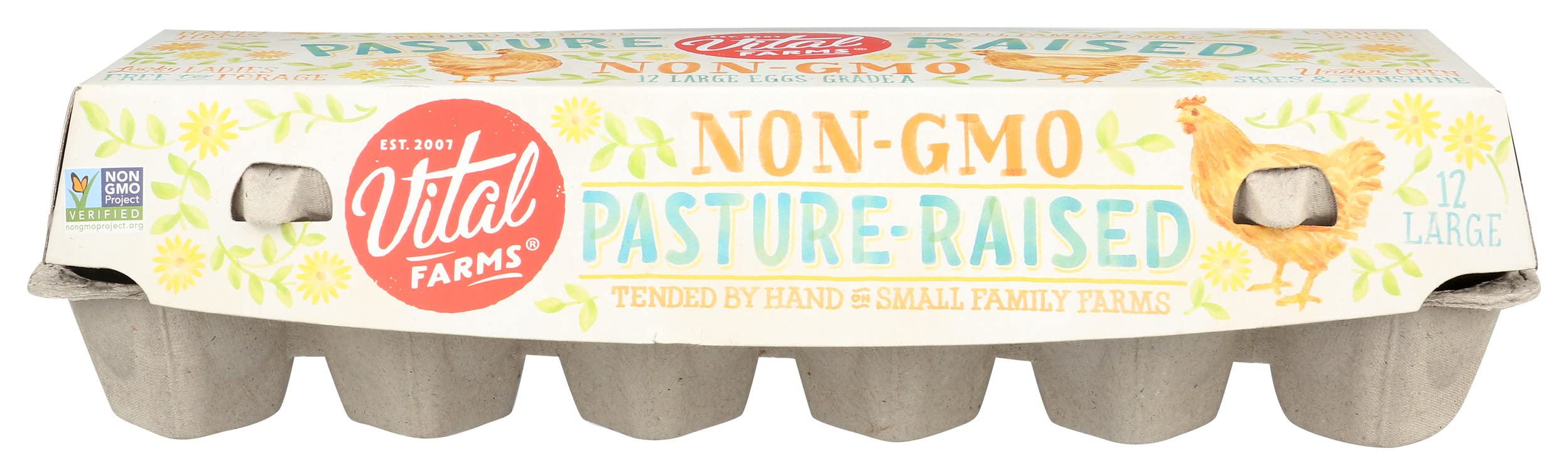
The most common pasture-raised standard, used by Vital Farms, requires 108 square feet of outdoor pasture per hen — roughly 100x more than cage-free. That's the size of a small bedroom for each chicken.
The hens forage during the day, eat bugs and grass on top of their feed, and return to a coop at night. Their diet is more varied; their movement is real. The egg they lay reflects this.
The label "pasture-raised" is not USDA-defined, but the major brands voluntarily adhere to the Certified Humane Pasture-Raised standard or the American Humane Pasture-Raised standard, both of which require the 108 sq ft minimum and are independently audited.
"Certified Humane: Pasture-Raised" or "Animal Welfare Approved"
Translation: The same as above, but verified by a third-party auditor with public standards.
This is the highest tier. A small number of brands carry it. Vital Farms is the largest by volume; smaller regional brands like Handsome Brook Farm and Happy Egg Co. also qualify in some product lines.
Why the price gap exists
A dozen pasture-raised eggs costs roughly 3× a dozen of caged eggs. The math is straightforward:
- Land: 108 sq ft per hen times 5,000 hens equals 12 acres of pasture. Caged hens use roughly 1/100th the land.
- Labor: Hens that forage outdoors require more daily care than hens in a controlled barn — moving coops, checking fencing, monitoring weather.
- Feed cost is similar, but the eggs per hen per year is lower (real movement, real winter).
- Mortality is higher without antibiotics in the feed.
You're paying for genuinely different farming, not for a marketing premium.
What's different about the egg itself
This is the part most articles overlook. Multiple studies — including a notable Penn State research project led by Dr. Heather Karsten — have measured nutrient differences between caged and pasture-raised eggs. The pasture-raised eggs in their dataset had:
- Twice the omega-3 fatty acids
- Three times more vitamin D
- Four times more vitamin E
- Seven times more beta-carotene
The reason is dietary: hens that eat actual grass, bugs, and varied forage produce a different egg than hens that eat formulated grain. Beta-carotene specifically gives the yolk its deep orange color — meaning yolk color is, in fact, a real marker of the hen's diet quality.
If you crack a $4 dozen and a $9 dozen side by side and the yolks look identical, someone is dying the feed to mimic the orange. Reputable pasture-raised brands don't do this. The orange comes from the grass.
How to read a carton in 30 seconds
In order of how seriously to take them:
1. "Certified Humane: Pasture-Raised" — buy with confidence 2. "Pasture-Raised" + a major brand name (Vital Farms, Handsome Brook, Happy Egg) — buy 3. "Free-Range" — better than cage-free, marginally 4. "Cage-Free" — minimal real improvement over conventional 5. "All Natural" / "Farm Fresh" — meaningless 6. No label at all — caged
Bonus signal: the yolk color when you crack one at home. Pale yellow = grain-fed indoor hen. Deep orange = real pasture or beta-carotene additive (or both).
Are pasture-raised eggs actually worth the money?
For an average family eating two dozen eggs a week:
- Conventional: ~$6/dozen × 2 = $12/week
- Pasture-raised: ~$8/dozen × 2 = $16/week
The premium is $4/week, or about $200/year. That's the price of one good restaurant meal.
In return: meaningfully better nutrition, hens that lived a real life, and farmland that — when grazed correctly — actually builds soil instead of degrading it.
We think that's a reasonable trade. We've made it our default for the last five years and don't regret a dollar of it.
What about local farm eggs?
The actual best eggs you can buy aren't in any supermarket. They're from a neighbor with a backyard flock, or a farmer at your weekly market. Those eggs:
- Were laid in the last 7 days (vs. 30-60 days for supermarket eggs).
- Came from hens whose diet you can ask about.
- Cost $5-7 per dozen, often less than supermarket pasture-raised.
If you have access to local farm eggs, buy them. If you don't, the pasture-raised brands above are the next best thing.